Article
The beginning of the end of the AIpocalypse

The AIpocalypse has been cancelled, and not by the sceptics. Last week Google and Google DeepMind published their AI and Economy ATLAS paper, built on about 15 million de-identified Gemini interactions and reviewed by economists Diane Coyle and David Autor. Its central finding is the one the industry has spent three years telling us to fear the opposite of: AI is not replacing jobs. It is being used, broadly and shallowly, as a collaborator. And I want to make the argument the press has been strangely reluctant to make. The apocalypse was never a forecast. It was a marketing campaign.
What Google’s data actually says
Adoption is astonishingly broad: AI usage now shows up in occupations covering 88% of US employment. Penetration is astonishingly shallow: the median occupation uses AI for about 21% of its tasks, and attempts at end-to-end automation account for less than 10% of conversations in non-routine cognitive work. This is not a workforce being replaced. It is a workforce looking things up.
And it is everyone’s workforce, not just the laptop class. Among the paper’s most over-represented users are automotive technicians and industrial mechanics, using multimodal AI to interpret test results, trace wiring faults and inspect machinery for wear, at more than twice the baseline rate. Home vehicle repair and appliance fixes rank among the top household activities. The white-collar apocalypse turns out to look a lot like a very good manual.
Google frames the productivity puzzle as a new Solow paradox: AI seemingly everywhere except in the productivity statistics. Its answer is that the gains are real but unmeasured, perhaps $100 billion a year in US household time savings that GDP cannot see. Read that generously and it is a measurement problem. Read it plainly and it is quite an admission: three years and the better part of a trillion dollars in, the transformation is happening somewhere the data cannot find it.
Two caveats, because the paper is honest about them and I should be too. The dataset excludes paid enterprise API usage, so enterprise automation is precisely what it cannot see, and Anthropic’s Economic Index suggests that blind spot matters: consumer conversations split roughly 52% augmentation to 45% automation, but enterprise API traffic runs closer to three-quarters automation. “Not yet, and not visibly” is not the same as “never”. But it is a very long way from half the entry-level jobs gone by 2030.
The AIpocalypse was a sales pitch
Here is the uncomfortable part. The catastrophe story did not come from doomsaying outsiders. It came from the people selling the product. Sam Altman wrote in January 2025 that “we are now confident we know how to build AGI as we have traditionally understood it.” Dario Amodei forecast AI “broadly better than all humans at almost all things” by 2026 or 2027, and told Axios that half of all entry-level white-collar jobs could vanish within five years. Terrifying capability, conveniently, is the product on the price list. Nobody budgets an emergency transformation programme for a very good manual.
The industry has form here. Herbert Simon, in 1965: “Machines will be capable, within twenty years, of doing any work a man can do.” Marvin Minsky, to Life magazine in 1970: “In from three to eight years we will have a machine with the general intelligence of an average human being.” Neither came true, and each cycle of overclaiming ended the same way, in the field’s two funding winters. Winters never followed underperformance. They followed unmet promises.
Was this cycle’s catastrophizing sincere belief or deliberate manipulation? I cannot see inside anyone’s head. But when the people with the most to gain from panic are the ones supplying it, and their own usage data quietly contradicts them, sincere forecasting gets harder to credit. My fear is that we have been, in effect, manipulated, and that a press hungry for an apocalypse story has been far too comfortable relaying the vendors’ script unchecked.
The toaster precedent
Marketing hyperbole outrunning reality is as old as the appliance business, and my favourite example is the toaster. In the 1910s and 1920s the electrical industry sold toast as the future of domestic life. Utilities went door to door pitching that “each electrical outlet in your home is a potential source of comfort and leisure”; toaster advertising promised elegant toast at the breakfast table, far from the messy kitchen; a 1924 Toastmaster advert put the machine in cafeterias, steamships, hospitals and hotels. The destination, plainly, was toast everywhere. The reality settled at one toaster per household. That still made it one of the most successful appliances ever sold: by 1988, 89% of American households owned one. And the technology peaked early. The Sunbeam Radiant Control toaster, designed in 1949 and produced in variants into the 1990s, lowers the bread itself and watches the toast rather than a timer, and among people who care about these things it is still widely considered the best toaster ever made. More than 75 years on, nobody has meaningfully improved on it. The toaster did not fail. It simply stopped being the future and settled into being furniture.

Science fiction, as usual, got there first. Red Dwarf gave its crew Talkie Toaster, an artificially intelligent breakfast companion whose formidable cognition funnelled into a single question: would you like some toast? The crew found the experience calamitous. Its relentless upselling drove them to distraction, and Lister eventually took a lump hammer to it. The joke was never that the toaster was intelligent. The joke was that all that intelligence existed to sell toast. Thirty-five years on, an industry has built genuinely remarkable machine intelligence and pointed a startling amount of it at getting you to engage, subscribe and upgrade. Talkie was written as satire. It is starting to read like documentation.
That is my bet for AI in its current structural form: enormously widespread, genuinely useful, and far shallower than advertised. A tool that helps nearly everyone a little - the mechanic reading a wiring diagram, the lawyer summarising a bundle, the developer scaffolding a test suite - and outright replaces almost no one.
What the next models will and will not be
Let me be precise about what has stalled, because “AI has plateaued” is half right and the wrong half usually gets quoted. Pretraining, the engine of the last five years, is exhausted; as Ilya Sutskever puts it, “there is only one internet.” GPT-5 arrived in August 2025 as a refinement, not a leap. Meanwhile capability on other axes kept climbing: METR’s measurements of how long a task a model can complete autonomously have doubled roughly every 7 months since 2019, and hard reasoning benchmarks are still being ground down. Progress has changed engine, not stopped.
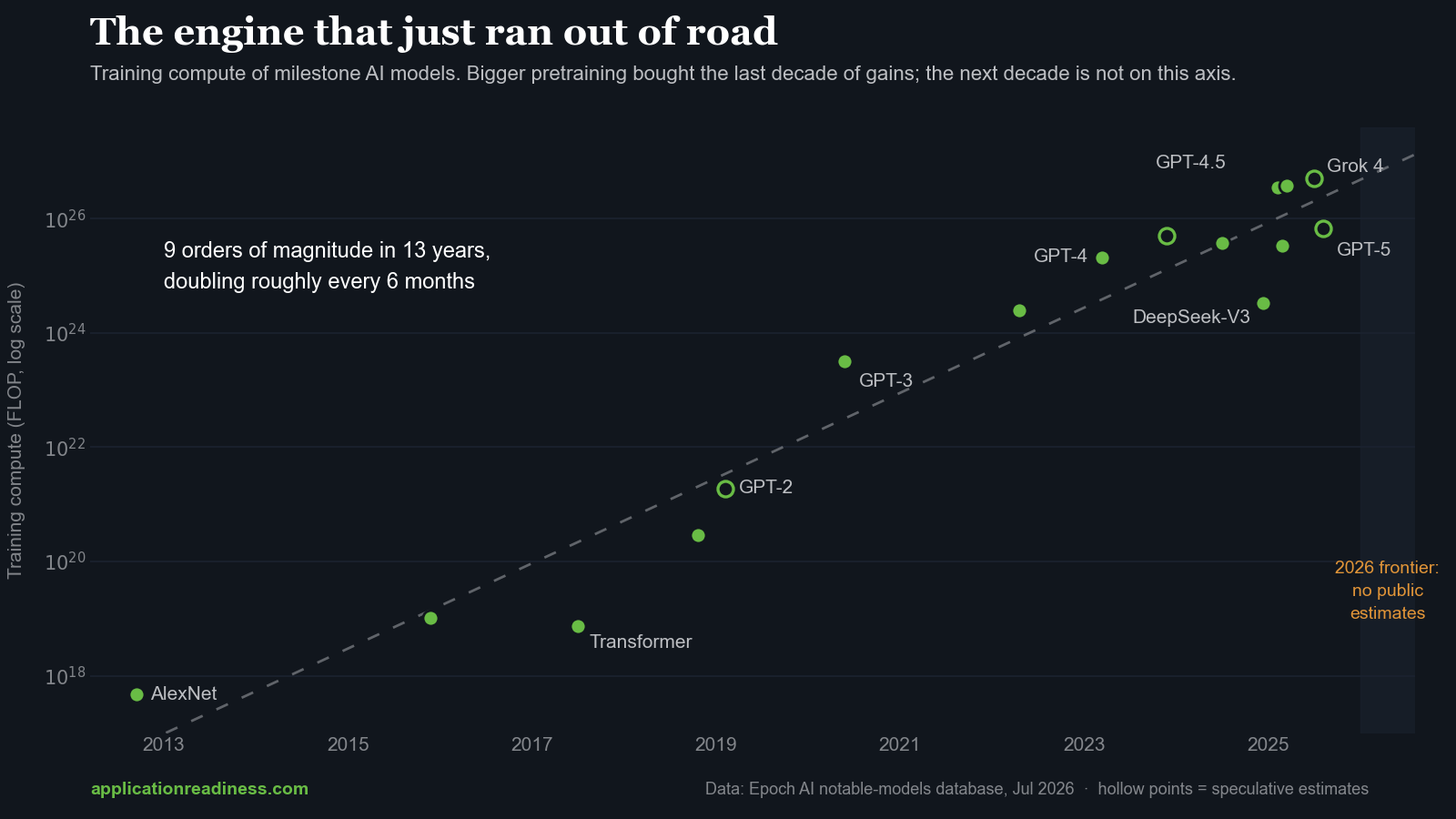
But I no longer expect the step change, the next Gemini or the next Fable being better the way GPT-4 was better than GPT-3. One of the odd lessons of this era is that specificity has been the enemy of AI: the impressive generality came precisely from the vast general corpus, and narrow fine-tunes have routinely disappointed. With the broad corpus spent, I expect the industry to mature the way every industry does: into products. Domain-trained models rolled up into versioned families, priced by field - a medical model priced like a medical device, an automotive one like a diagnostic rig, a cybersecurity one like an enterprise appliance - with cheaper commodity models underneath. Model competition becomes product competition. That is not decline. That is what growing up looks like.
The nadir is mine, not AI’s
Let me place the low point carefully, because it belongs to me. AI has not hit a wall. My enthusiasm has hit its nadir. I have been through this cycle before, first in the late 1990s as the field climbed out of its second winter, again when deep learning took off in the 2010s, and now. Each time the technology was real, the promises were not, and the people who kept using what actually worked came out ahead.
A nadir is a turning point, not a grave. I expect to be re-impressed, eventually. Just not by the next version number, and not because a vendor tells me the end of work is nigh. In the meantime, the operating advice for IT leaders is the same one this whole story teaches: buy delivery, not promise. AI already packages applications, runs comparison tests and drafts documentation, today, for money, and what it mostly does is relocate work rather than remove it. Plan for that and you bank the gain, whatever the Nasdaq decides the story was worth.
The Sunbeam was not the beginning of the toaster’s end. It was the end of its beginning: the point where the hype died and the appliance quietly took over every kitchen. That is where AI is heading, and it is a better destination than an apocalypse. The beginning of the end of the AIpocalypse is not the end of AI. It is the start of AI becoming furniture. Though not, if the vendors can help it, furniture that takes no for an answer. When Lister told Talkie Toaster he wanted no toast, no muffins, no crumpets, no teacakes and definitely no smegging flapjacks, the artificially intelligent appliance barely paused: “Ah, so you’re a waffle man.”
Every AI pitch I have sat through this year ends exactly the same way.
Footnote: the long-production classic of the Radiant Control line was the Sunbeam T-35, introduced in 1958. I leave you with a suspicion I cannot prove: that the T in T-800 never stood for Terminator, and that Cyberdyne’s model numbering simply carries on where Sunbeam’s left off. The T-35 was, after all, a chrome-plated machine that could not be bargained with, could not be reasoned with, and absolutely would not stop, ever, until you had toast.